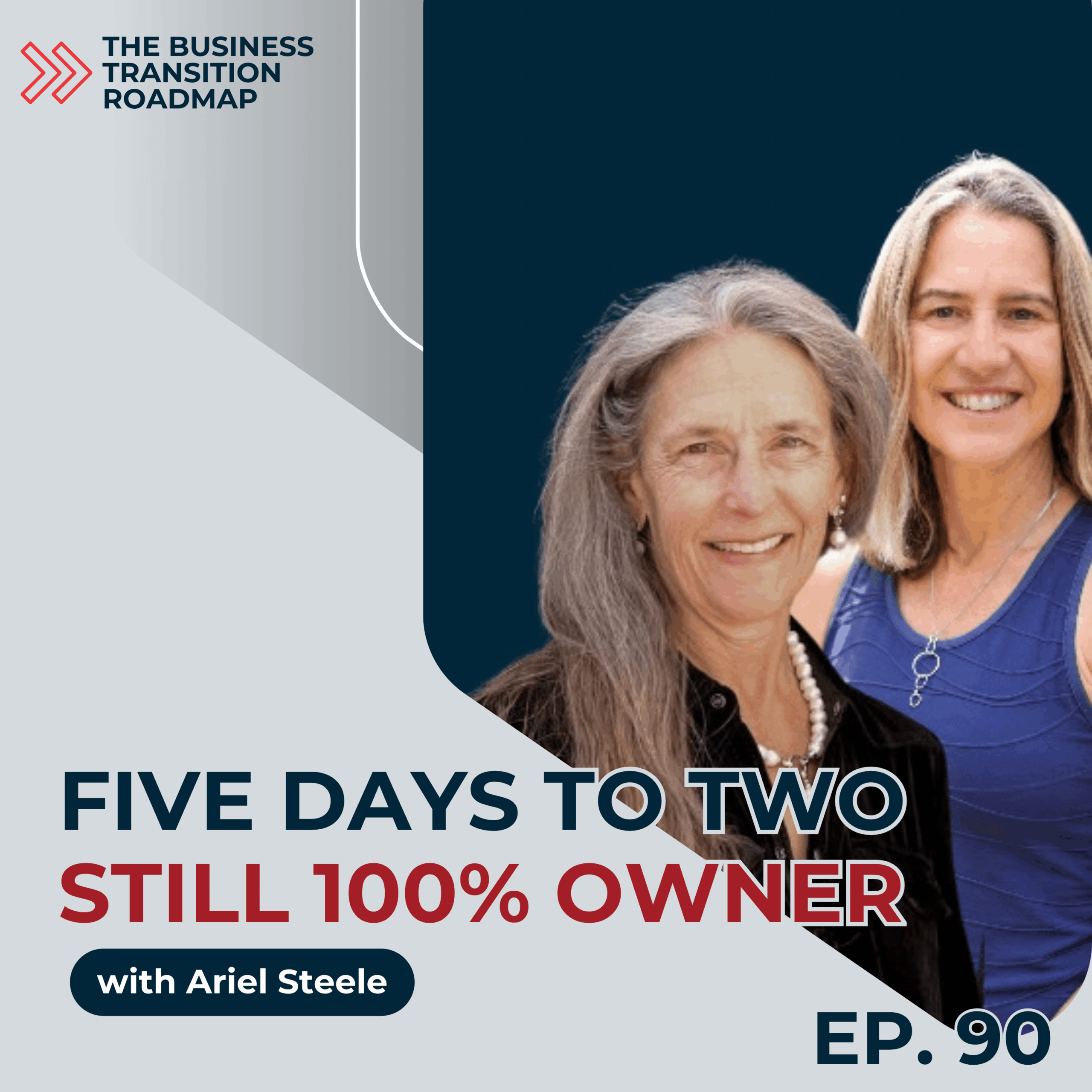
Episode Description:
Elizabeth talks with Ariel Steele, who has owned Tax Credit Connection in Colorado for twenty one years and who spent most of those years believing the business could only run through her. Ariel walks through the burnout that started the shift, the three years it took to build a team that could carry the work, and the mindset changes that had to come first. She still owns one hundred percent of the company and now works two days a week. This one lands squarely on role release without an ownership change, and it gives listeners a practical look at what an owner does with the time on the other side. Tap or click the play button below to listen to She Went From Five Days a Week to Two and the Company Grew Faster.
SCHEDULE A COMPLIMENTARY CONSULTATION
Most owners assume the business runs through them because it always has. Ariel Steele believed that for about twenty years, and then she changed it.
Ariel bought Tax Credit Connection at the end of 2005, when the company was barely a year old, after six months of running it for the previous owner. Twenty one years later she still owns all of it. What has changed is everything about how her week looks. She works two days, her five employees handle prospecting, contracts, negotiation, wires, and closings without her review, and she could be gone for a month without the company missing a step.
Elizabeth frames the move against the three part structure she uses in transition strategy, which separates role, big decision making, and ownership. Ariel released most of her role and shares a good deal of the decision making with her management team while keeping full ownership. That combination is what a lot of owners want and very few name out loud.
The honest part of this conversation is how long it took and what got in the way. Ariel spent years thinking the answer was the right hire or the perfect formula. It wasn’t. She was holding on too tightly, and the people around her had no certainty about what their jobs actually required. Once she got clear on that, the build itself ran about three years of documented processes, training videos recorded during every training, and better tools so everyone knows when their part comes up. She also stepped down in stages, moving from five days to four to three to two, and every time she took a day back she had to decide what came off her plate and which meetings she was leaving.
The second half turns to what happened with the time. Ariel wanted to be bored and never quite got there. She spent a year on health optimization and calls it a failed experiment. She traveled to India with her parents, helped them with a book, and eventually asked herself why she was so much happier than she had been a few years earlier. That question turned into Unexpected Happiness, a long format interview show where she talks with people who have come through serious personal challenges about how they managed themselves through it. She hired a producer in November, launched in March, and has about a dozen episodes out.
Key takeaways from the conversation:
- You can release the role and keep the ownership. Ariel still owns one hundred percent of a company she rarely works in.
- The mindset work comes before the systems work. Ariel had to change what she believed about her own necessity before any process could stick.
- People need certainty about what their jobs require. Vague direction from an entrepreneurial owner reads as risk to the team.
- Step down in stages rather than all at once. Each day Ariel gave up forced a decision about what left her plate.
- Growth did not suffer. Ariel’s most profitable year came after the team was in place, and she now hears compliments about her people rather than about herself.
- Talented people cost money. Top of range salaries, strong retention, and a pension plan are part of the arithmetic here.
Elizabeth closes on the belief loop she taught at the Evolve group labs earlier this year, which is that another person’s growth ties directly to how much they believe in your belief in them. Ariel’s version of that is simpler. She had been afraid, she behaved like it was not safe to make a mistake around her, and letting go of the fear is what let her team grow.
Chapters in this Episode:
00:00 – Welcome and introducing Ariel Steele
01:37 – Big law in Los Angeles and a year and a half in Palau
02:20 – Buying Tax Credit Connection and closing right before Christmas
03:00 – Twenty one years and three Colorado credit programs
03:40 – Burnout and the question of what comes next
04:17 – Roles, decision making, and ownership as three separate moves
05:01 – One hundred percent owner working two days a week
05:40 – What the team owns from prospecting through closing
06:00 – Management meetings, one on ones, and where Ariel still shows up
06:37 – How long this actually took
07:00 – Holding on too tightly and what had to change first
08:06 – Certainty, SOPs, and better project management tools
08:40 – What made her realize she needed to shift
08:54 – A business mentor and learning one tool at a time
09:49 – Doing it wrong together instead of taking the work back
09:59 – Going from five days to four to three to two
10:51 – Behavioral shifts and the step by step commitment
11:19 – It’s A Journey and the second edition
11:41 – Giving up control to get freedom
12:22 – Where the wins landed for the business and the people
12:52 – Wanting to get bored and never quite getting there
13:03 – A year of optimizing health and a failed experiment
14:00 – Helping her parents with their book and asking what changed
14:20 – Hiring a producer and launching Unexpected Happiness
14:58 – William Bridges and the space between an ending and a beginning
15:44 – India with her parents and getting satiated
16:24 – How much free time is actually free
16:54 – Five o’clock with her husband as close to non-negotiable
18:03 – The belief that ownership just works this way
19:19 – Did the company trade growth for the owner’s freedom
19:42 – The most profitable year and a flat 2026
20:45 – Top of range pay, retention, and a pension plan
20:59 – Belief in successors and the Evolve group labs session
22:17 – Culture, fear, and behaving like mistakes are safe
23:19 – Twenty years or thirty
24:05 – Inside the Unexpected Happiness podcast
26:17 – Ariel’s one thing for listeners
26:50 – Freedom, engagement, and closing
Connect with Ariel Steele: Linkedin: linkedin.com/in/ariel-steele-63241b415 Unexpected Happiness podcast: https://unexpectedhappiness.net/
Connect with Elizabeth Ledoux and the Transition Strategists:
Website: https://transitionstrategists.com/
Facebook: https://www.facebook.com/thetransitionstrategists
Elizabeth on LinkedIn: https://www.linkedin.com/in/elizabethledoux/
Transition Strategists on LinkedIn: https://www.linkedin.com/company/transitionstrategists/
Transition Strategists on YouTube: https://www.youtube.com/@transitionstrategists
Subscribe to “The Business Transition Roadmap with Elizabeth Ledoux” on your favorite podcast player:
Spotify: https://spoti.fi/3MxSYA2
Apple Podcasts: https://apple.co/3IhMMux
Our Sister Show: Your Next Gen Friend
Hosted by Andrea Carpenter, Your Next Gen Friend is for the next generation stepping into leadership in family and private businesses. If you’re a successor figuring out your path, this show is for you.
Website: https://yournextgenfriend.com/
Instagram: https://www.instagram.com/yournextgenfriend/
YouTube: https://www.youtube.com/@yournextgenfriend
Andrea on LinkedIn: https://www.linkedin.com/in/andreakcarpenter/
Spotify: https://yournextgenfriend.com/open-spotify
Apple Podcasts: https://yournextgenfriend.com/apple-podcast
Get Elizabeth Ledoux and Laura Chiesman’s latest book, “It’s A Journey: The MUST-HAVE Roadmap to Successful Succession Planning”: https://amzn.to/3oq2LQv
She Went From Five Days a Week to Two and the Company Grew Faster Transcript
Elizabeth Ledoux:
Hi everyone and welcome back to the Business Transition Roadmap. I’m Elizabeth Ledoux and today I am here with Ariel Steele. Ariel and I have known each other for quite some time, and I met her through her company called the Tax Credit Connection. she originally, well, and still
Right, helps landowners to earn money for preserving their land through conservation easement, income tax credits in Colorado. And she’s starting to work in some other states as well. So that’s how I originally met her. And in our conversation, we we reconnected a few months ago, and we she started talking about a new podcast series called Unexpected Happiness.
And it’s where she interviews people with challenging life circumstances to really learn about how they were able to overcome their challenges and stay happy during that process. So she’s got a couple of different passions. She’s an incredible woman and I’m so excited to have her with us today. So Ariel, welcome to our podcast.
Ariel Steele:
Thank you so much, Elizabeth. You’ve been such an inspiration to me over the years. It’s really fun to get to do this with you. Thank you.
Elizabeth Ledoux:
well thanks. I always like to kind of start out, you know, tell us a little bit about you, kind of how you got started with the tax credit connection and then how have you, you know, just maybe started to navigate some of the things that are important to you in your life?
Ariel Steele:
Yeah, that’s a great question. And so I started off my career originally as an attorney doing big law in Los Angeles. I quickly realized that that lifestyle was not the best for me long term and had an opportunity to go around the world to Micronesia and work on a tiny Pacific island called Palau. And I worked there for a year and a half as their assistant attorney general, and that sealed the deal that law was not gonna be the place for me.
but after that I really realized I wanted to do something to help protect land. And so I was able to work for the Boulder County Open Space Department doing conservation easement deals and I learned all about the tax credits that were the main incentive for people to donate conservation easements. in 2005 I was approached by the woman who owned Tax Credit Connection at that time. It was a baby company, about a year and a half old, and you know, just barely starting out.
And she needed help running it while she took on a full time job. So did that for six months and decided, hey, if I’m gonna do this, I wanna own it. So I made an offer to buy it from her and
bought it that that at the end of the year. We finished the closing just before Christmas. And I’ve been the owner of Tax Credit Connection ever since then. So it’s been twenty one years now.
And
yeah, it’s great. We
Elizabeth Ledoux:
Wow. Congratulations.
Ariel Steele:
Thank you.
Thank you. And it’s grown a bit. The program’s grown. Colorado now has three programs where you can sell tax credits. So we work with conservation, historic, and environmental. and that’s how I got to where I am now. But along the way, there’s been a lot of, you know, ups and downs. And I always knew I didn’t want to like do this until I went to the grave. I wanted to be able to bring people up behind me that could
run things, you know, possibly you know, sell it to someone one day. Like I bought it from the original owner. And when you and I first met, I was getting pretty burned out. Not when we first met, but like after we had met for a little while, I started feeling pretty burned out from just the the grind of feeling like I had to do everything myself. And so I was thinking about should it would an exit be the right thing? Would a joint venture be the right thing?
And ultimately I realized that just cutting my hours back and building a really great team that could have the opportunity for them to run the company with me as their coach and guide has been a great opportunity and allowed me to follow some passions of mine that are really new and just started in the last year. So that’s where I am now.
Elizabeth Ledoux:
Well that’s really exciting. And you know, in at the transition strategist in our work, and over the many years that I’ve done this, I kinda think of transition and transition strategy. The transition’s kind of in three buckets. And so role transition, right, governance slash big decision making and then ownership and it
To put a little structure around it, basically it sounds like you really moved out of some role ownership, but kept some some of the governance. I don’t know how you make decisions now in the company, if it’s part of the team that helps to make some big decisions or not, but kept that ownership.
Ariel Steele:
Yes,
yes. So it’s been I kept the ownership of the company. I still own it a hundred percent. but beyond that, all of the day to day, like I could be gone for a month and the company would run just fine with my team. we’re a small team. There’s five I have five employees and myself and I work two days a week and they do everything from, you know, the prospecting, they get the contract signed, they for people to sign up to work with us.
They negotiate the deals, they do the wires, they do the closing contracts. I don’t review any of those anymore because I have really competent people and we have lots of checks and balances and we have structured SOPs, we have training videos that we’ve created every time someone gets trained. But then what I do on my two days a week, I work is I do management team meetings every week. So the the three ladies that run the three different parts of the business, we all get together.
every week and talk through all the management issues. we structure it much like an EOS level ten meeting if that’s familiar to anyone who’s watching this. And then I have a one on ones with everyone. So some people every other week, some people weekly, and then I’m available for the things that are just, you know, that they need me in the room. You know, they need my voice in the room. But if I do a meeting with a client, I always bring someone in with me and it’s been great. Like they’re all getting to take on more responsibility than they
have ever had in their other jobs. So they’re excited and there’s enough checks and balances that everything gets done right.
Elizabeth Ledoux:
That is so great. So I’ll tell you, Ariel, many times people underestimate how long it takes to do what you’ve done. So if you had to estimate like when did you start this whole process and how long did it take you to get to where it was really functional, how what was that journey like?
Ariel Steele: Whew, well, it really it really was like doo doo because I didn’t change as much as I needed to when I was at this point. Like I kept thinking, I’ll hire the right person, I’ll, you know, figure out the perfect formula. But what was going on is I was holding things back. I was holding on too tightly to things, I wasn’t able to let go of control, I didn’t have really clear expectations in place.
So I had to change my own mindset and I had to change my own processes to be able to allow this to happen. Once I really took took it seriously, I would say three years of building that. So it wasn’t that bad once I once I realized okay, I need to have really clear SOPs and we need to prioritize getting this done.
I need to be sure that everyone knows exactly what’s expected of their jobs. I mean, I was kind of like a, you know, I was one of those entrepreneurs who like, yeah, yeah, do some of this and do some of that and you’ll know if it’s right. No, that does not work for people. They need to know,
Elizabeth Ledoux:
Yeah.
Ariel Steele:
they need some certainty. And I was not giving them certainty. I was giving them a lot of scariness. so once I could get clear on those things and we just keep refining it and getting better and better, and we have better tools now, so we have better ways to track things.
a br better project management tools so that everyone knows their role and when it’s time for them to do their part. So it just has been, you know, really in the last three years we’ve been building these things out, but I needed to do a lot of growing to get ready for it because I just wasn’t ready before.
Elizabeth Ledoux:
Yeah. And it’s it’s interesting. yeah, my question is what what helped you to realize that you needed to shift? What
happened
Ariel Steele:
Yeah.
Elizabeth Ledoux:
for you?
Ariel Steele: Yeah. lots of different little things. Like I had started going to a lot more personal and professional development kinds of programs starting probably in about 2017, 2018. So in the last, you know, eight years or so. And those were all helping me to realize that my mindset affects how I show up. And so while I kind of knew some of that stuff before, it started getting a little bit clearer.
I started working with a a business mentor and I’ve been working with him for six years now. And so that has given me access to tools. I learned about this many tools to begin with, and of course I couldn’t implement them all. So as I did one at a time, I kept seeing things more clearly. So don’t know if that really answers your question completely. But it was it was a process and it was being exposed to lots of different ways of thinking and finding the ones that worked for me.
And trying it out and doing it wrong and then getting it right later. Right. Right.
Elizabeth Ledoux:
Yeah. And doing it wrong. And and your team doing it wrong too, right? And working through it together instead
of you taking it back.
Ariel Steele:
Right, right. And y you know, and so sometimes I had to just say, I did it in steps. I didn’t go from five days a week to two days a week. I went from five to four to three to two. So every time I would say I’m taking a day, another day a week off, I’d have to figure out what’s coming off the plate. You know, am I which meetings am I not gonna go to anymore? Like going from three to two, I had to take myself out of a lot of meetings. And that was great because
They can do just fine without me. and we had had enough time with me being in them that they know what I was looking for, you know, what the format I was shooting for, and we had structure around it. But I didn’t need to be in their way anymore. But just by like saying, I am not gonna work these other days, you figure it out. But doing it in baby steps is really important. For me, it was.
Elizabeth Ledoux:
Yeah, and I that’s been my experience for many, many, many years, is that the people that are very intentional, that the owners that can make their behavioral shifts and their shifts in thinking
and work with the team to enhance them, you know, their skills and their abilities and they take it step by step. Then, you know, the name of our book is called It’s a Journey. Our second edition’s coming out maybe even this week, which is exciting.
Ariel Steele:
congratulations.
Elizabeth Ledoux:
Thanks, thanks. And you know, it truly is a journey because because three years once you figured it out and really could understand what you were trying to accomplish, that’s a significant amount of time for you to make a commitment that you’re gonna move from where you were to where you are today over that period of time.
Ariel Steele:
Right. And you just have to give up a lot of control. And you know, that’s not always easy. But I was finally able to realize if I don’t give up the control, I don’t get any freedom. And
Elizabeth Ledoux:
Yeah.
Ariel Steele:
it was too painful to stay where I was. And so I knew I needed to do that. And I’m so glad. I’m so glad. I mean, do they do everything perfectly? No, of course they don’t. But like I didn’t do everything perfectly. And when I was frazzled and trying to shove too many things into one.
you know, calendar, there’s things I wouldn’t even do at all and and they’re doing it and they’re doing many things better than I could do them. So it’s you know but you have this idea that you’re the only one who can do it and that’s just not true.
Elizabeth Ledoux:
Yeah. So you created kind of a win for the business, a win for the team and the people, a win for yourself, right? So so you’ve got that all up to date and that’s where you are now. what
motivated you what how did you know what your next adventure was? And you know, what were you gonna do with this time when you were thinking back three plus years ago, was it kind of like, hey, I’m just tired and I want open time? Or did
Ariel Steele:
Yes.
Elizabeth Ledoux:
you have something that you were really thinking about doing? I’m just curious.
Ariel Steele:
No, I started off
just thinking I wanted to have open time. Like I really wanted to get bored because I never feel bored.
Elizabeth Ledoux:
Mm-hmm.
Ariel Steele:
I was like, I wonder what it feels like to be bored. and I never really got bored, but the first year I just focused a lot on health and like I wasn’t in poor health. I just had this kind of obsession with like longevity and optimizing and that ended up becoming just exhausting. And it it was that was a failed experiment. But it was you know it was good to like try it out and see, you know, going
To functional medicine doctors getting all, you know. So I went down that path for about a year, realized that was not really serving me, and helped my parents with the book that they were writing, and thought, gosh, you know, I’m so happy now, and I was so unhappy a few years ago. What changed? How could I share that? Maybe I’ll share it in a book, maybe, you know, and so kind of research that books.
You kind of need a little bit of a following is what I was learning. So I thought, well, I’ll start a podcast. I love people, I love talking to people, I love learning their stories. And I thought, you know, the people who inspire me the most are the ones who you hear about where everything went wrong in their lives. But they were able to pick themselves up and make a great life or have a great outlook on it. And I thought if I’m around those kinds of people, I’m gonna learn so much and I’ll get to share their stories with everyone else.
So that’s what I started. I knew nothing about it. Like literally in October of last year, I thought maybe I’ll write a book. And then by November, I’d hired a producer and we were creating the podcast. And we started releasing it in March of this year. And we have either 12 or 13 episodes out there. And I just came back from interviewing two men over the last couple of days, one in Toronto, one in Boston. And it was just I can’t believe I get to do this. It’s just so rewarding.
So I just fell into
Elizabeth Ledoux:
Yeah.
Ariel Steele:
It. Like having the open space on my calendar allowed me to just see what what my heart wanted to do.
Elizabeth Ledoux:
Yeah. Yeah. There’s a there’s a book that I read a long time ago called Transitions.
Ariel Steele:
Mm-hmm.
Elizabeth Ledoux:
and yeah, by William Bridges. And it is phenomenal.
The the concept is for you to have a new beginning.
Ariel Steele:
Mm-hmm.
Elizabeth Ledoux:
you don’t need it’s not just the end of something else, but it’s that he calls it that transition, right? That that middle, that uncomfortable space between the end and then finding the right beginning for you. And you’re a yeah, you’re brave because a lot of people try to get through that quickly and don’t give themselves enough time to really understand what
What might be next and best for them?
Ariel Steele:
Mm. Yeah. No, it was it was great. It was fun to have that time. You know, another thing I did is spend a lot more time with family and did a big trip with my parents to India and did some things like that, which was great. saw some more friends and other like extended family. But I really realized like, okay, that was wonderful to kind of catch up, but I don’t need to spend like two months of every year visiting family. Like that was great for a year and
You know, so I got satiated on certain things, which was good to have give some time to it and then realize that was nice. Let’s find a happy medium and I feel good about that.
Elizabeth Ledoux:
Yeah. So how much of your free time is still free and how much have you moved to engulfing it in other things that are like the podcast?
Ariel Steele:
Yeah,
no, it there’s really not a lot of free time. I mean what is different is and but you know what that’s
what I love doing. Like I can’t help it.
Elizabeth Ledoux:
Entrepreneurs don’t do well sitting around doing nothing for very long. They’re just
Ariel Steele:
No.
Elizabeth Ledoux:
the they actually become unhappy, right?
so I could see you being active, of course.
Ariel Steele:
Yeah. I mean
what’s different though now that I love is like at five o’clock almost every day my husband and I get together and make dinner. We might go for a walk. You know, we do we hang out together pretty much from five o’clock till bedtime, which is huge. Like there would there would be weeks where there would not be a single night during the week where we would get to hang out, make dinner and not have to go back to work afterwards. So this is amazing and that is pretty close to non-negotiable. I want to keep that there.
so
Elizabeth Ledoux:
Sure.
Ariel Steele:
so there’s like pr certain parts of my life that are still have like that freedom and that ease that didn’t have it before. But to say like, I have just whole days with nothing on the calendar, no, I don’t. I I just to be honest, I don’t.
Elizabeth Ledoux:
well yeah, I mean that could be where you landed, where you have a happy life, that you’re engaged, you have a reason for getting out of bed, you feel fulfilled but not overloaded. it’s just a
nice
kind of cycle of life. Because I don’t believe there’s balance in life. I think there’s
Ariel Steele:
Important.
Elizabeth Ledoux:
a cycle of life and as long as the cycle’s moving the way you want it to, it’s happy. But
Ariel Steele:
Mm-hmm.
Elizabeth Ledoux:
you know, it’s interesting just to think about when you were engulfed in your business and, you know, working most evenings and not having the time with your husband and those kinds of things. Sometimes there’s a a thinking that goes on for quite a while that says if I’m gonna be an owner and I’m gonna
be in my own private business, life just is this way, right? Everything stops with me. I’m the one that, you know, when everybody else gets to go home at five, I’m still there. And, you know, that’s just what it means to be an entrepreneurial owner. Yeah.
Ariel Steele:
Yeah. No, that’s definitely what I thought it meant.
Elizabeth Ledoux:
Yeah. Yeah.
Ariel Steele:
And
it’s it doesn’t have to be. It doesn’t have to be. I’m living proof that it doesn’t have to be, but it’s not easy. Like you said, I worked at it for three years of actively building the team, building the systems. And I didn’t build them myself. them with my guidance. And you know, I obviously I paid them a salary to build them and you know, that kind of thing. But before any of that, I needed to change my beliefs that I’m the only one who could do these things.
And that’s not just part
Elizabeth Ledoux:
Yeah.
Ariel Steele:
and not everybody is gonna make that change and that’s okay.
Elizabeth Ledoux:
So
was there a trade-off in the growth of the company versus you right? And how did that end
Ariel Steele:
group bastard.
Elizabeth Ledoux:
up working out? Huh?
Ariel Steele:
It’s grown
faster with this team in place. you
Elizabeth Ledoux:
Yeah.
Ariel Steele:
know, this is a kind of a weird year, twenty twenty-six. We had our biggest, our most profitable and our biggest year last year. This year is going to be probably break-even if at best. But there’s a lot of reasons why and it should be doing well again in twenty twenty seven. But no, they they have been able to help us to do much better than when I was holding it all so tightly. So the company’s
Elizabeth Ledoux:
Yeah.
Ariel Steele:
grown more.
Now obviously I’m I’m paying for really talented staff. I mean their salaries aren’t free, that’s for sure. And you know, I have you know, I’m I’m paying at the top of the range. I’m bringing in people who are very skilled and I’ve had great retention, which has been wonderful. So that’s fantastic and you know, I’m creating a pension plan that they’ll be a part of, you know, I’m doing things that are designed to
help them feel appreciated and valued. So that’s not free. But as far as the company, it’s growing great without me holding off the
Elizabeth Ledoux:
Yeah.
Ariel Steele:
tight. And I get compliments all the time from people about my team. So that’s
Elizabeth Ledoux:
Yeah.
Ariel Steele:
always telling me that things are going well.
Elizabeth Ledoux:
Yeah, and it’s interesting because I asked that question to get your perspective, but almost
Ariel Steele:
Mm-hmm.
Elizabeth Ledoux:
every time an owner lets go and starts to pass more on to their team. And I just did well, I did a session in Las Vegas in January, and then I did on our Evolve group labs because we have our
Evolve program, and I just did a session on the concept that
Another person’s growth is directly related to your belief to their belief in your belief of them.
Ariel Steele:
Mm.
Elizabeth Ledoux:
to their belief of your belief in them. So
Ariel Steele:
Yeah.
Elizabeth Ledoux:
and it was a really cool session. It was very deep. But you know, the concept of how much do you believe in your successors and how much do they believe in your belief of them? Because
Ariel Steele:
Right.
Elizabeth Ledoux:
that’s really the key, right? Is if they believe that you believe in them, they can do amazing, incredible things. So yeah, so as soon as you were able likely to get that in place
they start to fly and instead of you trying to bury yourself and do it all, you’ve got people living, you know, a more balanced cycle of life and they’re able to do more together. So it’s really inspiring.
Ariel Steele:
Yes. Yeah.
it’s it’s been great. And you know, they are a really strong team together. I mean, we we do a lot to ensure that we are very close with each other, we look out for each other, we have a strong culture. and you know, I was a problem with the culture five years ago, ten years ago. I you know,
it wasn’t
While I’d say it was safe to make a mistake around me, I didn’t behave like it was safe to make a mistake around me. I was so worried and getting rid of that fear and allowing you know, knowing that that fear was holding me back from freedom made such a difference. And like getting rid of that fear allows them to flourish. And I I was holding it back.
Elizabeth Ledoux:
Yeah.
Yeah. It’s an interesting thing that sometimes even we can’t see it, right? But sometimes our own behavior just gets in the way of having what we really want. Without any question. Yeah. Yeah.
Ariel Steele:
Yes, so true. So true.
Elizabeth Ledoux:
If we could only look in a mirror and see it sooner. That would be such a blessing. Yeah. Yeah.
Ariel Steele:
I know, I know. Yeah. Well hopefully somebody listening
is like, gosh, I’m ready to make that change and they don’t have to take twenty years like I did.
Elizabeth Ledoux:
Yeah.
Well, or thirty like I did.
Ariel Steele:
Okay, there we go. Yeah.
Elizabeth Ledoux:
I’ve been working on it for a while. But
yeah, it’s yeah, it’s amazing. So, you know, it always amazes me too that our time goes so fast. So we’re almost at the end of our podcast. And
Ariel Steele:
Okay.
Elizabeth Ledoux:
this has been an incredible discussion, and I am so excited for you that you’ve been on this journey for all these years and made so much progress. It’s incredible.
Ariel Steele:
Feels really good. It feels really good.
Elizabeth Ledoux:
Yeah.
Yeah. So two things. One, tell us a little bit about the Unexpected Happiness podcast series, because I’ve listened to a couple of them and they really are so enlightening the way that you approach them. Yeah, so tell us a little bit about that. Yeah.
Ariel Steele:
Amazing guests. So
I have amazing guests and I let them tell their stories. It’s long format, so they run from anywhere from about thirty-five minutes to a little over an hour, depending on you know the conversation. And it it could be any situation. The most recent one we had was someone who had seriously considered suicide multiple times about a decade ago and he shared his story and how he’s gotten to where he’s so grateful that he
has his life and grateful that he went through that challenging period of depression to open up the the to take the stigma away from it so we can all talk about it. But then you know we have people who you may have dealt with a medical issue or something like that, financial issues. And so what I look for in the conversation is how they managed it. Like how they managed their state, you know, their how they felt
They acted and what we can take away from that. So all of us don’t have to go through these terrible situations to discover what can make us happier in our regular life. We can apply what they learned to our very mundane problems. But then if a big one comes, we have inspiration that yes, we can make it through that. So it’s been
Elizabeth Ledoux:
Yeah.
Ariel Steele:
wonderful for me, and I love that their stories get out there.
And it’s even better when people listen to them and learn something that they can apply in their lives.
Elizabeth Ledoux:
Yeah, that’s great. Well, thanks for doing that. And I think we can all learn so much from others’ experiences without any question. So I always ask this last question. so going back to our conversation, what what one thing would you like to leave with our listeners today?
Ariel Steele:
Well, I think the biggest thing is like think about how important freedom is to you. And it to some people it may be huge, to some people it may be small. And if it is really important to you, just gotta let go. And it’s not easy to do it, but once you do, like that’s the only way to get to true freedom is to get people that you trust and and empower them. So I just wanna encourage anyone who’s looking for that to
Take the step and do it. It’s worth it.
Elizabeth Ledoux:
That’s awesome. Yeah. And that’s so well said because sometimes I think
We believe that the opposite is true, that to get freedom we engage more. And usually that’s working against us. So yeah. Gosh, Ariel, thank you, thank you, thank you for sharing your story today and for being here on the podcast with us. I’m so appreciative. And you know, in our show notes we’ll have information about the tax credit connection if you’re interested in exploring that. It’s a pretty cool thing to look at for options as you’re moving forward in your estates and with your business.
yeah, as you navigate some transition strategies and then also information about the Unexpected Happiness podcast so that you can check out what Ariel’s doing today.
Ariel Steele:
Thank you. Thanks so much, Elizabeth. This has been lovely.
SCHEDULE A COMPLIMENTARY CONSULTATION
The Business Transition Roadmap with Elizabeth Ledoux
How do communities thrive? When businesses experience healthy growth and transition. Join CEO of The Transition Strategists, Elizabeth Ledoux as she and her guests identify what makes a successful business transition roadmap. If you know you want to transition or exit your business “one day”, today is the right day to start planning. This show will give you the roadmap.
If you’ve enjoyed this podcast, you can check out other episodes here: Podcasts – The Transition Strategists