Most business owners believe that succession planning is succession planning. A good attorney, a solid estate plan, the right financial structure, and you’re covered. Yet when you look closer at how transitions actually play out, something important emerges: the way you approach the process shapes everything.
It shapes whether your transition brings clarity or confusion. Unity or frustration. Momentum or resistance. And most owners don’t realize which methodology they’re using until it’s too late to change course.
That’s why I want to walk you through three transition models, ones we’ve seen play out time and time again. We call them Transition 1.0, 2.0, and 3.0. Once you understand the differences, you’ll be able to see exactly where you are right now, and where you might want to shift.
Transition 1.0: “I’ll Tell Them When It Happens”
This is the oldest approach, and it’s still surprisingly common. Everything stays in the owner’s head. Decisions are kept private. No one knows the plan, the timing or the reasoning behind it. It might be written in a will somewhere, yet it’s largely unspoken.
Owners choose this path because it feels controlled. They don’t have to make promises. Nobody feels entitled. And the intentions here are genuinely good. They’re trying to avoid drama, protect the people around them and keep the business stable.
Yet here’s what happens when it’s time to deliver that plan. Whatever the event, whether it’s a passing, a health issue or simply deciding it’s time, it lands like going off a cliff for everyone around you. Families are blindsided. Successors are unprepared. The shock alone can derail good decisions, especially when people are grieving or something difficult has just happened.
Resentment sets in. Relationships fracture. And in blended families or situations with strong emotional attachments, legal disputes follow. Even a plan built with the best intentions can explode when it’s delivered as a surprise. That’s where 1.0 falls short. No one else sees it coming.
Transition 2.0: Inform and Announce
Transition 2.0 was created to fix the disasters of 1.0, and it does move in the right direction. The idea is simple: tell them early. Announce the plan before it happens so your next generation isn’t blindsided.
The communication is better. The timing is earlier. Yet here’s the key piece: the plan is already decided. It’s built privately, typically with your technical advisors like CPAs, attorneys, estate planners and financial advisors. The family and key leaders are informed. They aren’t included in building it.
And this is where it gets tricky. When people receive a plan that’s already finalized, they tend to stay quiet. They don’t want to challenge the owner, especially when that owner is also their leader, their parent, their mentor. They want to be seen as grateful for the opportunity. So they stay silent.
“Transition 2.0 gives you compliance and it does not give you commitment. People live up to their commitments, not your expectations.”
That silence gets interpreted as agreement. Yet underneath it, people often aren’t aligned at all. It’s a quiet, ticking tension that surfaces later, sometimes long after you’re no longer in the picture to help resolve it.
There’s also an assumption built into 2.0 that everyone wants in. That all the kids want ownership. That everyone wants to be on the board, making decisions. That’s not always true, especially as families get bigger. And 2.0 doesn’t leave room to discover that.
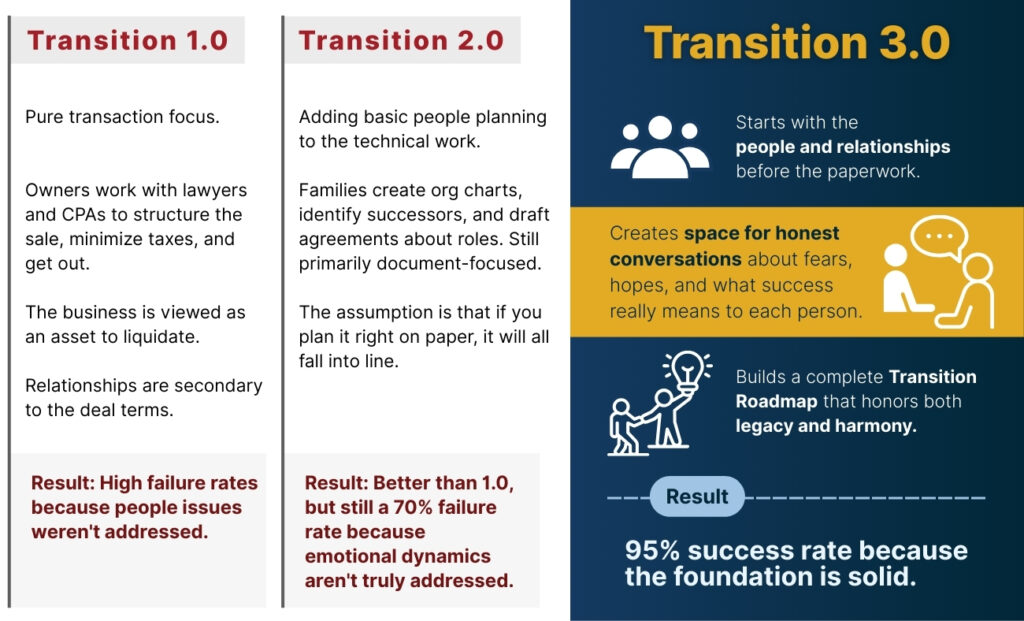
Transition 3.0: Collaborative Design
This is where things change. Transition 3.0 is built around one idea: you can build the future with the people who will live in it.
It doesn’t mean you’re giving up authority or handing over control. It means you’re creating alignment before the decisions are finalized, so that the plan is durable, supported and understood by everyone it affects.
In 3.0, you bring the right people into the conversation early. You clarify values, roles and timelines together. You uncover motivations and concerns before they turn into conflict. Anyone who values their relationships knows that getting ahead of conflict is a big deal. It’s much easier to build trust now than to try to repair it later.
And here’s what it replaces: buy-in replaces compliance. Clarity replaces assumptions. Unity replaces quiet resentment. The roadmap isn’t imposed. It’s designed together.
Why 3.0 Consistently Works
Sixty percent of transitions fail even with perfect legal documents and estate plans. The reason is almost always the same: they didn’t take care of the human side.
Transitions fall apart because of assumptions, unspoken commitments, misaligned visions, personality differences and confusion about roles and authority. 1.0 and 2.0 solve the technical side. Yet the human side, the relationships and the clarity people want and need to move forward together, is exactly what only 3.0 addresses.
“People support what they help create. That’s the foundation.”
When both generations co-design the path forward, the transition sticks. It works. Transition 3.0 protects relationships, strengthens leadership and builds a business that can stand the test of time. It’s the first model that consistently works because it finally includes the part every other model ignores.
It’s also why our success rate at The Transition Strategists is over 90%, in an industry where the average hovers around 30%.
So Where Do You Stand?
When you look at these three models side by side, the evolution becomes clear. We’ve moved from secrecy, to early announcement, to finally including the people who actually have to live with these decisions.
1.0 hides everything until the end. 2.0 shares the plan yet hides the thinking. Only 3.0 opens up the process in a way that creates real alignment. And if you want a transition that actually works, one that keeps your relationships intact and gives the next generation a roadmap they believe in, 3.0 is where you want to be.
The real question isn’t whether you have a plan. It’s whether your plan was built with the people who have to carry it forward.
Ready to build your transition the 3.0 way?
Evolve is our coaching and implementation program designed for business owners leading a transition. It takes everything we talked about here, continuity, clarity and shared design, and turns it into a structured, step-by-step roadmap that you build with the people who matter most.
You’ll get personalized coaching, one-on-one support from a Transition Guide and a peer community that helps you navigate challenges and maintain momentum every step of the way.
Explore Evolve and start building your transition roadmap together.